It's 75 Degrees in Dallas. Your Cousin in Chicago Still Thinks You Need Snow Tires.
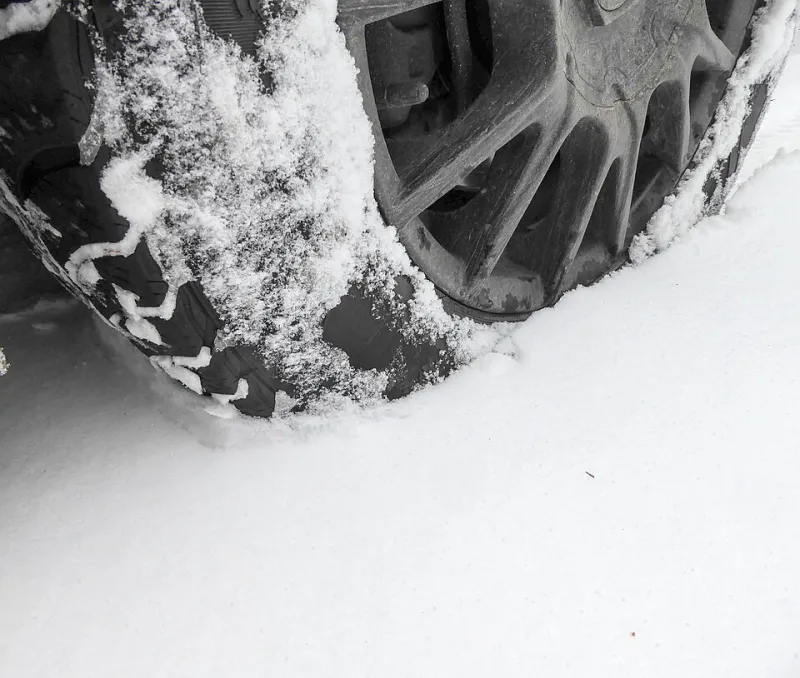
Photo: HopsonRoad, CC BY-SA 4.0, via Wikimedia Commons
Every winter, the same debate plays out in group chats and hardware store parking lots across America: do you really need winter tires?
The honest answer is that the question is unanswerable without a map. Tire advice is regional advice, and almost nobody frames it that way. Your brother-in-law in Minneapolis swears by his Blizzaks. Your coworker in San Diego has never owned anything but all-seasons and thinks the whole thing is a scam. They're both right — about their own zip codes.
The All-Season Myth, Measured by Thermometer
The term "all-season" is one of the great marketing victories of the last 40 years. It doesn't mean all weather. It means the tire hit a compromise: a rubber compound that stays flexible enough below freezing for light snow, but doesn't turn to mush in summer heat.
That compromise works fine in places like the Carolinas, Tennessee, or the DC suburbs — climates where snow shows up a handful of days a year and roads get treated quickly. It works less fine in places where winter is a season rather than an event.
The rubber compound is the whole story. Summer and performance tires harden like a hockey puck below about 45°F, which is why a Florida car with great tread can still slide on a cold, dry morning. Winter tires use softer compounds and siped tread blocks that stay pliable in the teens. An all-season is a jack of two trades and master of neither — which is fine in moderate climates, and a gamble everywhere else.
A Rough State-by-State Reality Check
Nobody's writing you a tire prescription without seeing your actual driving, but here's the honest regional breakdown we give friends:
The Upper Midwest and Northeast (MN, WI, MI, upstate NY, ME): Real winter tires, full stop. If you're running all-seasons here, you're accepting longer stopping distances every day from December through March. Dedicated winters on cheap steel wheels, swapped every spring, is the playbook.
The Mountain West (CO, UT, MT, WY): Winter tires or the Three-Peak Mountain Snowflake (3PMSF) symbol on the sidewall. Colorado's traction law literally requires it on I-70 during storms. If you see that little snowflake-in-a-mountain icon, the tire has passed an actual snow traction test — an "M+S" marking has not.
The Pacific Northwest (WA, OR): All-weather tires earn their keep here. You get rain-slick roads most of the year and occasional mountain passes. Something like the Michelin CrossClimate covers both without a seasonal swap.
The South and Southwest (TX, AZ, NV, FL, GA): Winter tires are money burned. Your enemy is heat, not cold. A standard all-season rated for high treadwear, checked for pressure monthly (heat swings tire pressure hard), is the right call. In Arizona especially, UV damage and dry rot will age out a tire before the tread does — check the date code.
The Mid-Atlantic and transition zones (VA, KY, MO, KS): The genuine gray area. A good all-weather tire — not all-season, all-weather — is the sweet spot. More on that below.
When All-Weather Tires Are Actually Worth It
The all-weather category is the newest and most misunderstood. These are tires engineered to carry the 3PMSF snow rating while still wearing well in summer. They sacrifice a little dry braking performance and tread life versus a pure all-season, and they're not as good in deep snow as a dedicated winter tire.
But for the huge swath of America that gets some snow, some rain, and some heat — think Tennessee, Ohio, Kansas, Pennsylvania — one set of all-weathers year-round is a genuinely rational choice. No swap fees, no garage shelf of mounted wheels, no getting caught in an early storm on the wrong rubber.
The upgrade justifies itself when: your winters are unpredictable, your daily route includes bridges or rural roads that get plowed last, or you've ever white-knuckled it home in surprise weather. If you live where it reliably dumps two feet at a time, skip the middle ground and buy real winters.
The Part Nobody Mentions: Your Driveway Counts Too
A steep gravel driveway in Vermont changes the math. A job that has you commuting at 5 a.m. before the plows run changes the math. So does a rear-wheel-drive muscle car, which will find a way to make even good tires look bad in the rain.
Tires are the only four contact patches between two tons of steel and the asphalt. Everything else on the car — the engine, the brakes, the fancy safety tech — ultimately works through them. Buying the right ones for your climate, not your cousin's, is the cheapest insurance you'll ever get.
Check your sidewalls this week. Note the size, the load rating, and whether there's a snowflake symbol. Then match that against where you actually drive — not where the internet says you live.