Your Car Is Trying to Tell You Something — And Your Suspension Is Doing All the Talking
There's a weird thing that happens with daily drivers. You get so used to the way your car feels that you stop noticing when it starts to feel wrong. The ride gets a little bouncier, the steering feels a touch vague, the front end dips a bit more than it used to when you brake — and you just... adapt. You chalk it up to road conditions, maybe a rough stretch of highway, or just the car getting older.
But here's the thing: your suspension doesn't go bad overnight. It degrades slowly, quietly, and often without triggering a single dashboard warning light. By the time something obvious shows up — a clunk, a pull, a shimmy you can't ignore — you might already be dealing with secondary damage that's costing you way more than a simple component swap would have.
Let's talk about what's actually going on under your car, how to spot the early signs, and why staying ahead of suspension wear is one of the smartest maintenance moves you can make.
What Your Suspension Is Actually Doing
Most people think of suspension as just "the stuff that absorbs bumps." And yeah, that's part of it — but it's a pretty small part. Your suspension system is responsible for keeping your tires in consistent contact with the road, managing weight transfer during acceleration and braking, maintaining proper steering geometry, and making sure your vehicle handles predictably in every situation.
Shock absorbers and struts are the obvious players, but the system also includes control arms, ball joints, tie rod ends, bushings, sway bar links, and springs. Every single one of those components works in coordination. When one starts to wear, the others compensate — and that compensation has limits.
The Warning Signs Most Drivers Miss
Because suspension wear is gradual, the early signs are easy to dismiss. But if you know what to look for, you can catch problems long before they snowball.
Uneven tire wear is one of the biggest tells. If your tires are wearing faster on one edge than the other, or you're seeing a cupping pattern on the tread, your alignment or shock absorbers are likely off. This is often the first visible clue that something is wrong with the suspension geometry.
A pulling sensation while driving straight is another one. If you're constantly making micro-corrections to keep the car centered in your lane, that's not just annoying — it's your alignment telling you something is out of spec.
Excessive nose dive when braking or body roll when cornering suggests your shocks or struts are losing their ability to control weight transfer. A car that feels like it's "floating" over bumps or takes a while to settle after hitting a dip is showing classic signs of worn-out dampers.
Clunking, knocking, or squeaking sounds — especially over speed bumps or when turning — often point to worn ball joints, loose sway bar end links, or deteriorated bushings. These sounds are your car begging for attention.
Steering that feels loose or vague is particularly worth taking seriously. If there's more play in the wheel than there used to be, or turning feels disconnected from what the front wheels are actually doing, tie rod ends and ball joints are the usual suspects.
The Domino Effect Nobody Talks About
Here's where neglected suspension maintenance gets expensive in a hurry. These components don't fail in isolation — they fail together, because worn parts put extra stress on everything around them.
Take a worn shock absorber as an example. When it can no longer properly dampen the up-and-down motion of the wheel, your tire starts bouncing more aggressively over road imperfections. That increases wear on your tires unevenly. The extra movement also stresses your ball joints and control arm bushings, accelerating their wear. Meanwhile, the constant misalignment puts strain on your steering rack. What started as a $150–$300 shock replacement can quietly turn into a $1,000+ repair ticket if you let it ride long enough.
Alignment is another classic domino. A car that's out of alignment doesn't just wear tires — it affects handling stability, can mask brake performance issues, and puts lateral stress on tie rod ends that weren't designed to handle it. A $100 alignment done at the right time can save you $400 in tires and another few hundred in steering components.
Why Diagnosis Matters as Much as the Parts
One of the biggest mistakes people make with suspension issues is throwing parts at the problem without a proper diagnosis. Replacing shocks when your real issue is a worn control arm bushing will give you a temporary improvement that fades fast — and you'll be back in the shop wondering why the new parts didn't fix things.
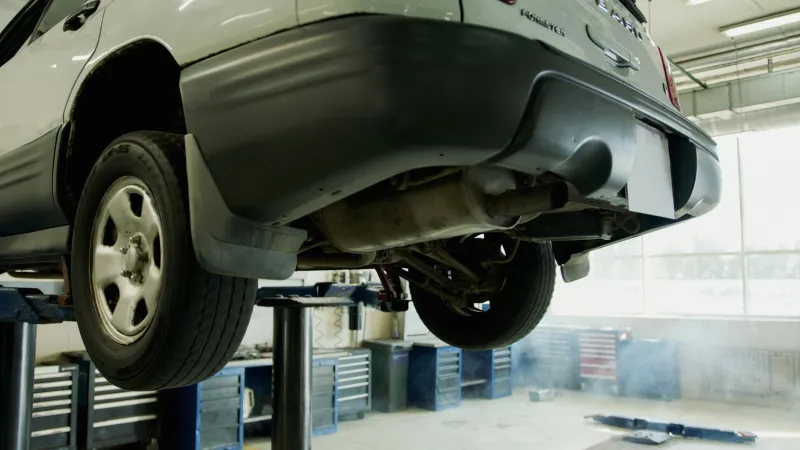
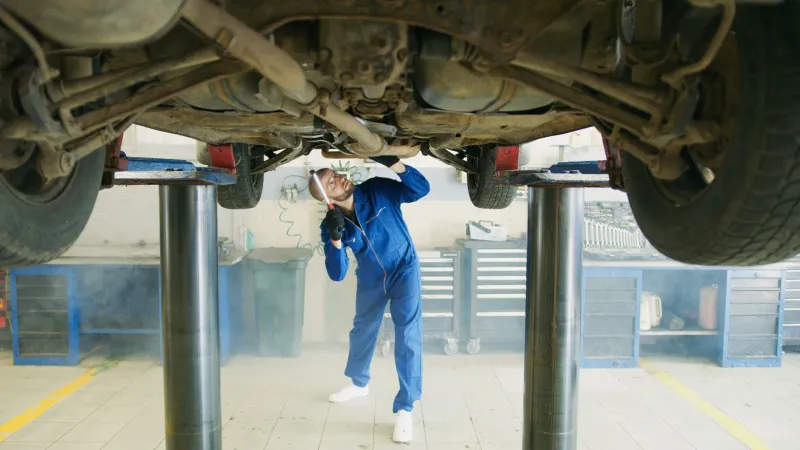
A thorough suspension inspection involves getting the vehicle on a lift and physically checking for play in every joint, inspecting bushings for cracking or deterioration, measuring alignment angles, and looking for signs of uneven wear that indicate geometry problems. It's not a complicated process, but it requires someone who knows what they're looking for and isn't just hunting for the most obvious (or most profitable) repair.
At Hueco Automotive, we look at the whole picture — not just the component that's making noise right now, but what that worn component is doing to everything else in the system. That's how you avoid paying for the same problem twice.
Getting Back to That New-Car Feel
If you've been driving your vehicle for a few years and it just doesn't feel as planted or confident as it used to, there's a decent chance your suspension is overdue for some attention. Most shock absorbers and struts are designed to last somewhere between 50,000 and 100,000 miles, but that range varies significantly based on driving conditions, road quality, and load.
Living in a city with rough pavement, frequently driving on gravel or uneven surfaces, or regularly carrying heavy loads will all accelerate wear. If you're hitting that mileage range and haven't had a suspension inspection, it's worth putting it on the schedule — even if nothing feels dramatically wrong yet.
The goal isn't just comfort, either. A properly functioning suspension is a safety system. It keeps your tires on the road, gives you the steering response you need to react in an emergency, and ensures your brakes can do their job effectively. A car that handles predictably is a car you can trust.
The Bottom Line
Your daily driver isn't supposed to feel like a boat on choppy water or a shopping cart with a wobbly wheel. If it does — or if it used to feel better than it does now — your suspension is probably the place to start looking.
Don't wait for a dashboard light that may never come. The signs are there if you pay attention, and catching them early is almost always cheaper, faster, and safer than dealing with the fallout later. Give your suspension the same attention you'd give your oil or your brakes, and your car will reward you with the kind of ride quality you thought only came with a new vehicle.