Why Your Tires Are Wearing Out Fast — And Rotation Alone Won't Save Them
Every time you pull into a quick lube or dealership, someone's going to recommend a tire rotation. Every 5,000 miles, every 7,500 miles, every oil change — the schedule varies depending on who you ask. And look, rotations aren't bad advice. Done correctly and at the right time, they genuinely extend tire life. But here's the part nobody mentions: if your tires are wearing unevenly, rotating them without diagnosing why is a little like rearranging deck chairs. You're moving the problem around, not fixing it.
Uneven tire wear is one of the most misread signals in automotive maintenance. And the cost of misreading it? Easily $1,500 to $2,500 in premature replacements that could have been avoided.
The Rotation Routine Isn't One-Size-Fits-All
Most rotation schedules are built around a generic assumption: that your vehicle wears tires evenly enough that swapping positions every few thousand miles will balance things out over time. That works reasonably well on a flat-road commuter with a balanced suspension and fresh alignment. In the real world, though, a lot of us aren't driving those conditions.
Front-wheel-drive vehicles put steering, power delivery, and braking stress all on the front axle. Those front tires can wear up to twice as fast as the rears. Rear-wheel-drive trucks and performance cars have their own imbalances. All-wheel-drive systems create yet another set of wear dynamics — and many AWD vehicles have tight tolerances on how much tread difference is acceptable between axles before you're risking differential damage.
The point is, your vehicle's wear pattern is specific to your vehicle, your roads, and your driving habits. A blanket mileage interval doesn't account for any of that.
What Uneven Wear Is Actually Telling You
This is where it gets important. When you pull a tire off and look at the tread, the wear pattern is basically a diagnostic readout. Shops that just rotate without inspecting the wear pattern are skipping the most valuable information available.
Here's a quick breakdown of what different patterns mean:
Center wear (worn down the middle, edges look fine): Classic overinflation. The tire's center is carrying too much load because the sidewalls aren't flexing properly. Check your PSI against the sticker inside your driver's door — not the max pressure on the tire sidewall.
Edge wear (worn on both outer edges, center looks okay): This one's usually underinflation. The tire is bowing outward, putting more contact on the shoulders. It also generates more heat, which accelerates the breakdown of the rubber compound.
One-sided edge wear (only the inner or outer edge is worn): This is an alignment issue. When your camber angle is off — meaning the tire is tilted inward or outward relative to the road — it scrubs one edge of the tire continuously. No amount of rotation will fix this. You need an alignment.
Cupping or scalloping (dips or high/low spots around the tread): This is almost always a suspension problem. Worn shocks or struts cause the tire to bounce and skip across the road surface instead of maintaining consistent contact. The tire literally hammers itself into an uneven pattern. Rotating a cupped tire just moves that irregular wear to another corner of the car.
Feathering (tread blocks worn rounded on one side, sharp on the other): Toe misalignment. Your tires are pointed slightly inward or outward instead of straight ahead, causing them to scrub sideways as you drive.
When Rotation Helps — And When It's Just Buying Time
Rotation is genuinely useful when your tires are wearing relatively evenly and you're just trying to equalize the faster-wearing positions with the slower ones. Keeping all four tires at comparable tread depths means you get more total mileage out of the full set and maintain consistent handling.
But if you're seeing any of the patterns described above, rotation is a band-aid. You might slow the damage slightly by moving a badly worn tire to a less stressed position, but the underlying cause — misalignment, worn suspension components, improper inflation — is still there, still doing damage.
Worse, moving a tire with cupping or feathering to the rear of a front-wheel-drive car can actually introduce a vibration or handling instability you didn't have before. Now you've got a new symptom that might send you chasing a balance problem that was actually a suspension problem all along.
The Inspection Step Most Shops Skip
A proper tire service visit shouldn't just be pulling tires and moving them to new positions. Before any rotation, a technician should be looking at:
- Tread depth at multiple points across each tire — not just one spot in the center
- Wear pattern analysis — comparing inner edge, outer edge, and center wear
- Tire pressure on all four tires — and adjusting to spec before rotating, not after
- Visual inspection of suspension components — ball joints, tie rod ends, struts — for obvious wear or damage
- Brake inspection while the wheels are off — since you've already got them in hand
If a shop is rotating your tires in under 15 minutes without checking any of this, they're completing a task, not servicing your vehicle.
Alignment: The Most Underrated Tire Saver
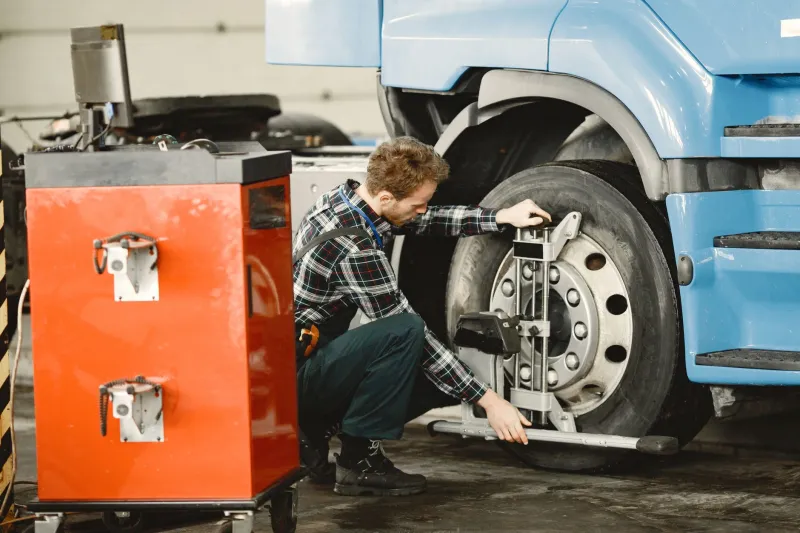
If there's one service that delivers more return on investment for tire longevity than any rotation schedule, it's a proper four-wheel alignment. A vehicle that's even slightly out of spec — we're talking fractions of a degree — will scrub through tires dramatically faster than one that's dialed in.
The tricky part is that misalignment often doesn't feel dramatic. Your car might not pull hard to one side. You might not notice anything unusual in everyday driving. But your tires are quietly paying the price every single mile.
If you've hit a significant pothole, curb, or road debris — and let's be honest, American roads give you plenty of opportunities for that — it's worth getting an alignment check, not just waiting for the next rotation interval.
What to Do Before Your Next Rotation
Next time you're due for a rotation, take five minutes in your driveway first. Crouch down and look at each tire straight-on. Run your hand across the tread from inside edge to outside edge. Feel for any roughness, ridges, or unevenness. Compare the inner shoulder to the outer shoulder.
If something looks or feels off, don't just book a rotation — ask for a wear pattern inspection and an alignment check. Spend $80 to $120 on an alignment now, and you might save yourself from replacing a $600 to $800 set of tires six months earlier than you should have to.
Rotation is a tool, not a cure. Used correctly, it's one part of a smart tire maintenance strategy. Used blindly, it's an expense that delays the real conversation your car is trying to have with you.
At Hueco Automotive, we believe good maintenance means actually listening to what your vehicle is telling you — not just checking boxes on a service sheet. Your tires have a story written right into the tread. It's worth learning to read it.