The Cheap Part That's Quietly Killing Your Gas Mileage
Let's talk about something that probably hasn't crossed your mind since your last oil change — if it crossed your mind then at all. Your engine air filter. It's not glamorous. It's not expensive. And it's almost certainly not getting the attention it deserves.
Here's the uncomfortable truth: if you've been driving more than 15,000 miles without swapping yours out, there's a solid chance you're leaving real fuel economy on the table every single day. And depending on where you drive — dusty roads, heavy stop-and-go traffic, construction zones — that number could be a lot less than 15,000.
What Your Engine Is Actually Trying to Do
Internal combustion engines run on a mixture of fuel and air. That part most people know. What fewer people think about is the ratio. For a gasoline engine to run efficiently, it needs roughly 14.7 parts of air to every 1 part of fuel — that's what engineers call the stoichiometric ratio. When that balance gets thrown off, the engine compensates. Usually by burning more fuel.
Your air filter sits at the front of that equation. Its job is to let clean, unrestricted air into the intake system while blocking dust, debris, pollen, and road grime. When the filter gets loaded up with that stuff — which it absolutely will over time — it starts restricting airflow. The engine's fuel management system detects the drop in oxygen and adjusts accordingly, often richening the fuel mixture to compensate. More fuel, same distance. That's a loss in MPG, plain and simple.
The EPA has noted that replacing a clogged air filter on older carbureted vehicles can improve fuel economy by as much as 14%. Modern fuel-injected cars are smarter about compensation, but that doesn't mean you're off the hook — restricted airflow still affects throttle response, acceleration, and overall engine efficiency. You might not feel it as a dramatic drop, but your gas station visits are quietly telling the story.
The Symptoms You're Probably Ignoring
A severely restricted air filter doesn't always announce itself with a check engine light. Sometimes the signs are subtle enough that drivers just chalk it up to "the car getting old."
Things to watch for:
- Sluggish acceleration — especially when merging onto the highway or passing someone
- Rough idling — the engine sounds or feels uneven at a stop
- Reduced throttle response — you press the pedal and there's a lag before anything happens
- Fuel economy that's quietly dropped — you're filling up more often but your driving habits haven't changed
- A faint fuel smell — if unburned fuel is making it out of the exhaust, that's a sign of a rich mixture
None of these individually scream "air filter." That's exactly why this part gets overlooked. It's not a dramatic failure. It's a slow bleed.
How to Check It Yourself Right Now
Here's the good news: inspecting your air filter takes almost no tools and about two minutes of your time.
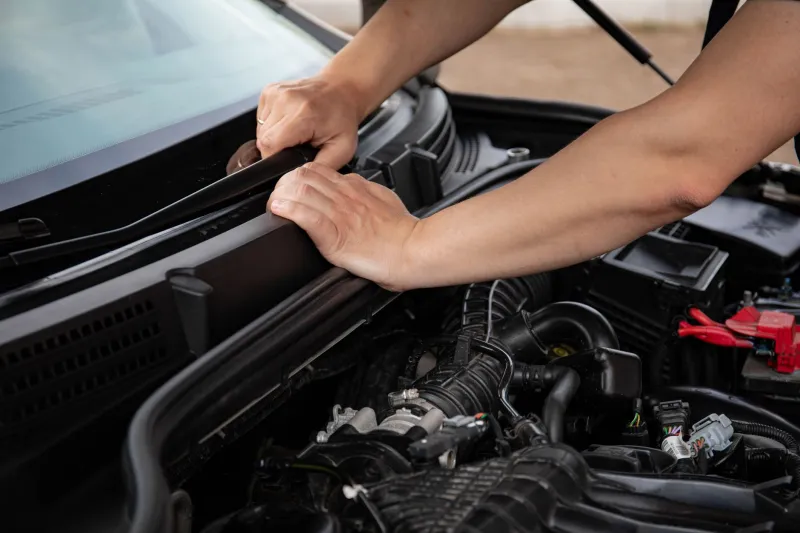
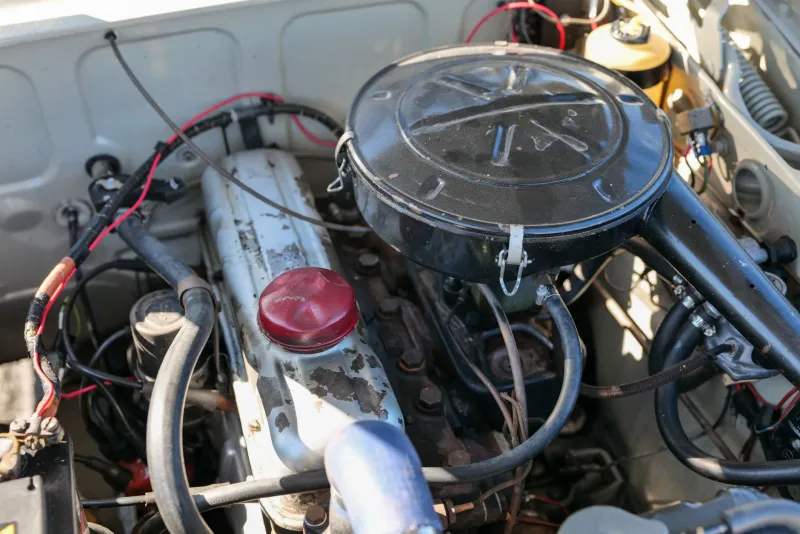
Pop the hood and locate the air filter housing — it's typically a black plastic box connected to a large hose that runs toward the engine. On most vehicles, it's held shut by a few clips or a single bolt. Open it up, pull the filter out, and hold it up to a light source.
A clean filter is usually white or light gray and you can see light passing through the pleats fairly easily. A filter that needs replacement will be noticeably darker — brown, gray, or outright black in the pleats — and you may see visible debris, bugs, or grime packed into the folds. If you're on the fence, give it a gentle tap against a hard surface. If a cloud of dust comes out, you've got your answer.
No dealer visit required. No diagnostic fee. You just looked at it.
The Marketing-Driven Interval Problem
Most owner's manuals suggest replacing the air filter every 15,000 to 30,000 miles under "normal" driving conditions. Shops will often default to recommending it every 12,000 miles regardless — because it's an easy upsell and a low-effort service item.
The reality is that "normal" driving conditions cover a pretty narrow slice of actual American driving. If you're commuting through a city, dealing with construction detours, driving on unpaved roads, or living somewhere with high pollen counts (looking at you, basically the entire Southeast in spring), your filter is working harder than the interval assumes. You might legitimately need to swap it out more frequently.
On the flip side, if you're doing mostly highway miles in a low-dust environment and you're only at 18,000 miles, your filter might look perfectly fine. Check it visually and let that guide you — not a generic sticker on your windshield.
What Replacement Actually Costs
This is where it gets almost embarrassing. A quality air filter for most common vehicles runs between $15 and $35 at any auto parts store. If you buy it and install it yourself, the labor is literally zero — it's a clip and a box. Even if you have a shop install it, the job takes five minutes and shouldn't cost more than a small service fee on top of the part.
What shops sometimes charge when they bundle it into a service package — or present it as a "recommended maintenance item" during an oil change — can be significantly higher. Always ask what the part costs separately and whether installation is included. You can almost always do this one yourself.
Aftermarket vs. OEM: Does It Matter Here?
For standard air filters, most quality aftermarket options perform just as well as OEM equivalents for everyday driving. Brands like K&N, Fram, and Purolator are widely available and well-regarded.
If you're interested in a reusable high-flow filter — the kind you clean and re-oil rather than replace — those are worth considering if you plan to keep your vehicle long-term. The upfront cost is higher (typically $50–$80), but they're designed to last the life of the vehicle with periodic cleaning. They can also improve airflow marginally compared to standard paper filters, though real-world MPG gains from that alone are modest.
For most people, a quality disposable filter replaced at the right interval is all you need.
The Bottom Line
Your air filter is one of the cheapest, easiest maintenance items on your entire vehicle. It's also one of the most consistently neglected. A clogged filter doesn't just hurt fuel economy — it makes your engine work harder, dulls throttle response, and over time puts unnecessary strain on other components trying to compensate.
Take two minutes this weekend. Pull the housing open, look at the filter, and make a call. If it's been more than a year or you can't remember the last time you checked it, there's a good chance you're already overdue. A $20 part and five minutes of your time might be the easiest MPG improvement you make all year.